
The Mental Game of Golf: What Tour Players Know That You Don't
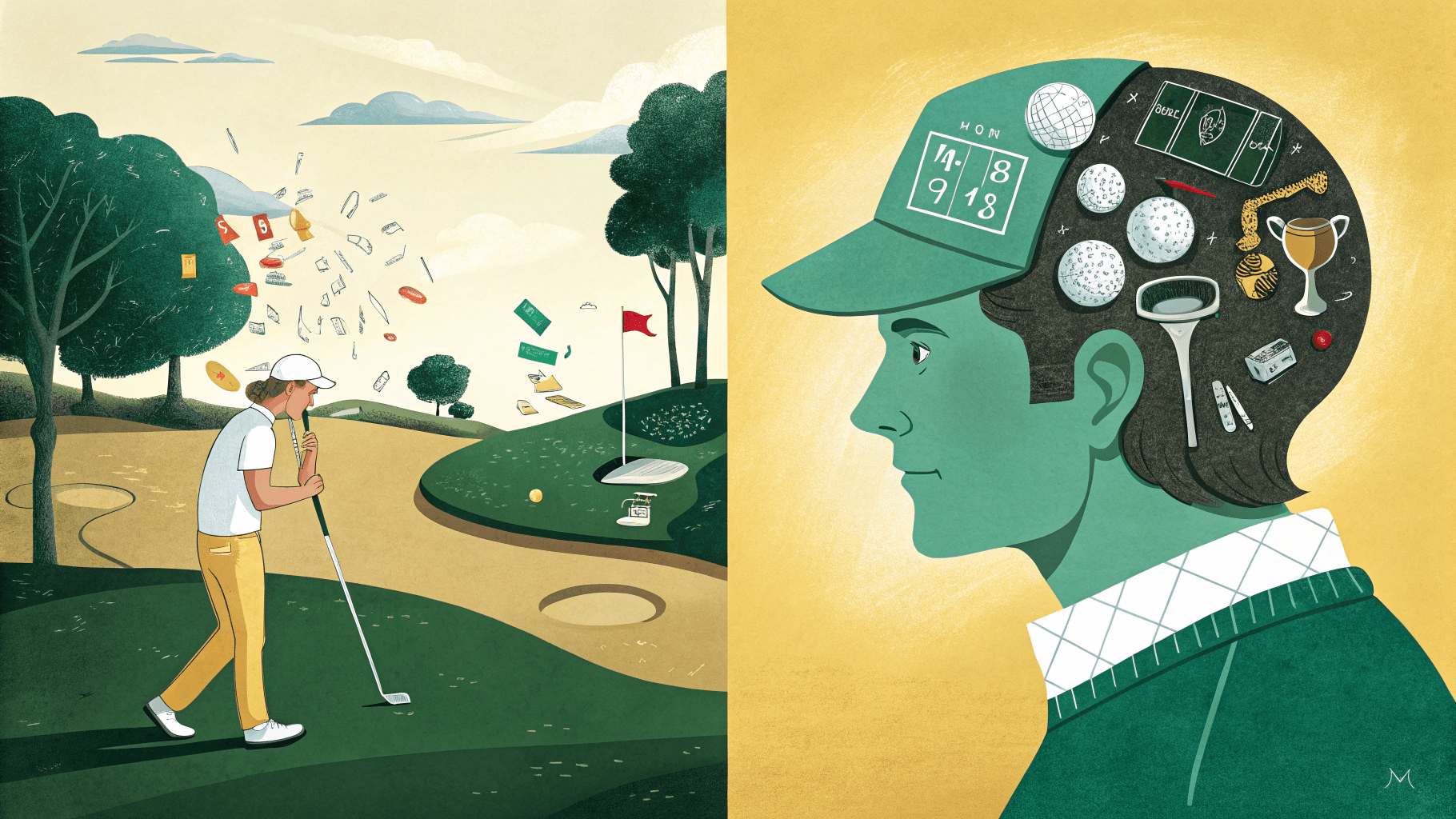
Tour players don't think less than you — they've just trained themselves to let unhelpful thoughts pass without resistance. Your brain generates roughly 70,000 thoughts daily, and fighting that mental noise only makes it louder. The real edge isn't thought control; it's learning to reset between shots, stay process-focused, and execute without your ego hijacking the scorecard. Keep going, and you'll discover exactly how they do it.
Why Your Brain Is Golf's Biggest Obstacle
Your brain might be the most sophisticated piece of equipment you bring to the course—and also your biggest liability. Jack Nicklaus believed golf, the mental game, accounts for 90% of performance, yet most golfers obsess over swing mechanics.
Here's the problem: your brain generates roughly 70,000 thoughts daily. That's constant mental noise disrupting every shot.
When you try controlling those thoughts, you activate your prefrontal cortex, which interferes directly with motor signals your body needs to execute freely.
The mental game of golf isn't about thinking less—it's about thinking differently. Elite players don't experience fewer negative thoughts than you do. They simply handle them better.
The mental game isn't about silencing your mind. It's about changing how you use it.
Tour players often rely on a one-thought focus protocol to reduce cognitive load and keep swing mechanics from overrunning their mental process.
Understanding mental golf starts with accepting that your brain isn't the enemy. How you respond to it is.
What PGA Professionals Actually Focus On Between Shots?
Most golfers obsess over their last bad shot or dread the next difficult hole—but PGA Professionals do the opposite. They deliberately reset between shots, using that walking time to breathe, release frustration, and return to neutral.
You don't see tour players replaying errors or calculating worst-case scenarios. Instead, they focus on process—managing energy, staying present, and preparing mentally for the next shot only.
Research shows 75% of PGA Professionals play without swing thoughts. That's intentional. They've learned that quiet minds execute better than busy ones.
Between shots, your job isn't analysing mechanics—it's recovering emotionally and arriving at the ball ready.
One shot at a time isn't a cliché. It's the actual strategy separating professional performance from amateur frustration. When it's time to pull the trigger, elite players rely on external attention cues rather than internal mechanical thoughts, directing focus toward a target or feel rather than body movements.
Why Trying to Control Your Thoughts Makes Everything Worse
The moment you tell yourself not to think about a bad shot, you're already thinking about it. That's not a personal weakness — it's how your brain works.
The second you try not to think about a bad shot, you already are.
Trying to control your thoughts adds a layer of mental complexity that actually fires up your prefrontal cortex. That's the part of your brain responsible for analysis, and when it's active during your swing, it disrupts the motor signals your body needs to execute naturally.
The best players on tour don't experience fewer negative thoughts than you do. They simply handle them differently. Instead of fighting what surfaces mentally, they let thoughts pass without resistance. Translating this into on-course mental performance means building practical pre-shot and between-shot routines that create psychological distance from unhelpful thoughts rather than attempting to suppress them.
Control is the problem, not the solution. The harder you grip your mind, the tighter your body follows.
How Overthinking Locks Your Body and Kills Your Swing
Research confirms that an internal focus on body mechanics actually stiffens your joints, turning a fluid motion into a mechanical, error-prone sequence.
Tour players counter this by using pressure inoculation during practice — deliberately simulating tournament conditions so the nervous system learns to perform under stress before it matters.
You can break this cycle by simplifying your pre-shot routine — make your decision, commit to it, and let your body execute without interference.
Analysis Paralysis Explained
Picture yourself standing over a key putt, running through every tip you've ever heard — keep your head down, soft hands, smooth stroke, don't peek. That mental checklist isn't helping. It's freezing you.
Analysis paralysis happens when conscious thinking overrides your body's natural movement system. Your pre-frontal cortex floods your motor signals with instructions, creating stiffness and hesitation.
Here's what that looks like in real time:
- Your grip tightens unconsciously
- Your tempo becomes mechanical and forced
- Your attention shifts inward instead of toward the target
- Your confidence dissolves before you've even swung
Your body already knows how to putt. It is learned through repetition. The moment you start narrating every movement, you interrupt that system completely, turning a trained skill into a conscious struggle.
Internal Focus Stiffens Joints
What happens inside your body when you overthink isn't just mental — it's physical. When you shift your attention inward — analysing your grip, elbow, or hip turn mid-swing — your muscles tighten. Research confirms that internal focus stiffens your joints, disrupting the fluid, automatic movement your body already knows how to perform.
Your nervous system needs freedom to execute motor patterns. The moment your pre-frontal cortex hijacks the process, it interrupts the smooth signals your muscles depend on. The result? A jerky, mechanical swing that feels nothing like your range session.
External focus — on the target, the ball's flight path, or a spot on the fairway — keeps your body loose and reactive. You don't swing better by thinking more. You swing better by thinking less.
Simplify Your Pre-Shot
Your pre-shot routine shouldn't be a checklist of swing thoughts — it should be a release valve. The moment you crowd it with mechanics, you've already lost the shot.
Separate your decision from your execution — choose your target, commit, then let go.
The best routines are dead simple:
- See it — visualise the shot shape and landing spot clearly
- Feel it — take one practice swing that captures the sensation, not the technique
- Trust it — step in knowing the decision is made
- Execute it — swing to a target, not through a checklist
One shot. One focus. Your body already knows what to do — your only job is to stop interrupting it.
Why Your Ego Is Quietly Wrecking Your Scorecard
Your ego slips into your round quietly, tying your confidence to your scorecard and sending it crashing the moment you make a bogey.
When your self-worth rises and falls with every number you write down, you're playing emotionally reactive golf instead of smart golf.
Shifting your attention to the process—one decision, one swing, one shot at a time—strips the ego of its power and keeps your game stable under pressure.
A mental performance coach helps you build that separation between identity and outcome, so your scorecard stops having a say in how you play the next shot.
Ego Hijacks Your Scorecard
When your ego takes the wheel, your scorecard pays the price. It ties your confidence to your score, so one bad hole unravels everything. You're no longer playing golf — you're protecting your identity.
Here's what ego-driven golf looks like:
- You attempt heroic shots to impress playing partners instead of playing smart
- Your confidence collapses after a bogey because your self-worth dropped with it
- You obsess over outcomes rather than executing the shot in front of you
- You carry frustration from the last hole into the next one
Process focus is the antidote. When you commit to each shot equally, regardless of the score, ego loses its grip.
Every shot demands the same effort — nothing more, nothing less.
Score-Dependent Confidence Collapses
Score-dependent confidence is a trap most golfers don't realise they've walked into. When your confidence rises and falls with your scorecard, your ego's running the show. Birdie on three? You're unstoppable.
Double bogey on four? Suddenly, you're questioning everything.
That's not mental strength—that's emotional fragility dressed up as competitiveness.
Your confidence shouldn't depend on what happened two holes ago. Every shot demands equal effort, equal focus, equal commitment.
When you tie your self-worth to your score, you're handing pressure a weapon it'll use against you all round.
Process-focused players don't collapse after a bad stretch because their confidence isn't borrowed from the scorecard. It's built on preparation, routine, and presence—things no bogey can take away.
Process Focus Defeats Ego
Ego doesn't announce itself—it just quietly inflates every shot into a referendum on your worth as a golfer. When your confidence rises and falls with your scorecard, you're letting ego drive. Process focus pulls you back.
Why shifting to process defeats ego:
- It replaces outcome anxiety with present-moment execution
- It removes the emotional weight attached to each individual shot
- It keeps confidence stable regardless of what the scorecard says
- It redirects your energy toward what you can actually control
Every shot demands equal effort—not more pressure because the hole is difficult, not less because you're playing well. When you stop performing for a score and start committing to each shot, ego loses its grip and your real game shows up.
The Pre-Shot Routine That Separates Pros From Amateurs
What separates pros from amateurs often comes down to one overlooked habit: the pre-shot routine.
Without one, you're stepping into each shot carrying whatever mental baggage preceded it—doubt, frustration, or distraction.
A solid pre-shot routine has three steps: see it, feel it, then hit it.
First, visualise exactly where you want the ball to go.
Then take a practice swing to feel the movement.
Finally, step in and execute without second-guessing yourself.
This sequence does something powerful—it separates your decision from your execution.
You've already committed to the shot before you swing.
That commitment quiets overthinking and lets your body perform naturally.
Tour players aren't just warming up physically.
They're resetting mentally before every single shot.
You should be, too.
What Visualisation in Golf Actually Requires
To visualise effectively, engage all your senses:
- See the ball's flight path, shape, and landing spot clearly
- Feel the club's weight, your grip pressure, and the swing's tempo
- Hear the clean contact between clubface and ball
- Trust the image completely before stepping into your stance
When you commit to the full picture, your body follows the blueprint your mind creates. Visualisation done right isn't wishful thinking—it's deliberate preparation that directly improves execution.
How Tour Players Handle Bad Shots Without Unravelling
Even the best players in the world hit bad shots—what separates them is how quickly they move on. Tour players don't fight their mistakes; they acknowledge them, breathe, and redirect their focus to the next shot.
When you dwell on a bad shot, you carry that weight into the next one. Your confidence drops, your muscles tighten, and suddenly one poor shot becomes three. That's not a skill problem—it's a mental one.
What works is using your routine to reset emotionally. Jason Day famously adopted a nothing-to-lose mindset after frustration, which freed him to play his best golf. You can do the same. Acknowledge the feeling, let it pass, and bring your full attention back to what's directly in front of you.
Why Playing One Shot at a Time Actually Works
Playing one shot at a time sounds simple, but your brain constantly fights it. It wants to calculate scores, replay mistakes, and preview disasters.
Your brain never stops fighting the present moment—calculating, replaying, and catastrophising. One shot at a time is harder than it sounds.
That mental noise pulls you out of the present and wrecks execution. Tour players aren't immune to this—they've just learned to compete differently.
Here's what actually happens when you commit to one shot:
- Your pre-shot routine becomes an anchor, returning you to the present
- You stop competing against the course and start executing your process
- Pressure shrinks because one shot feels manageable, not overwhelming
- Your body moves more freely without the weight of past or future shots
Each shot demands equal effort and attention. When you bring your best self to this shot only, performance follows naturally.
Four Mental Habits That Hold Up Under Tournament Pressure
Tournament pressure exposes every weakness in your mental game. But four habits keep elite players grounded when the stakes rise.
Process focus. Direct your attention to execution, not outcomes. Scores fluctuate when ego leads; consistency follows when process does.
Pre-shot visualisation. See the shot before you hit it. Mentally feeling the swing first reduces anxiety and sharpens execution.
Mistake recovery. Acknowledge frustration, breathe, then redirect toward the next shot. Jason Day's nothing-to-lose mindset turned frustration into freedom. You can do the same.
Mindful awareness. Notice your thoughts without fighting them. Creating space between you and your mental noise keeps your body loose and your decisions clear.
These aren't complicated. They're repeatable.
Under pressure, repeatable habits beat willpower every time.
How to Access Flow State Before and During a Round
Those four habits don't just protect your game under pressure—they set the stage for something better: flow. Flow isn't forced; it's accessed. You create conditions that invite it in before you ever reach the first tee.
Start building access points into your pre-round routine:
- Arrive early and warm up mentally, not just physically—nervousness shrinks when you're already settled
- Visualise each shot before swinging: see it, feel it, then trust it
- Stay curious about each shot instead of judgmental—curiosity quiets your inner critic naturally
- Focus one shot at a time, releasing the last and ignoring the next
When you stop chasing flow and start creating space for it, it finds you consistently.
References
- https://www.drpaulmccarthy.com/post/the-mental-game-of-golf-pro-secrets-you-haven-t-heard-before
- https://golfstateofmind.com/5-mental-mistakes-in-golf-that-tour-pros-hardly-ever-make/
- https://stix.golf/blogs/rough-thoughts/golf-psychology-12-tips-to-level-up-your-mental-game
- https://www.pgawest.com/pga-west-blog/top-strategies-for-mastering-the-mental-game
- https://www.youtube.com/watch?v=du-8X8xI2p8
- https://www.youtube.com/watch?v=ZCahQc50xhk
- https://briancain.com/blog/pga-radio-brian-cain.html
- https://www.youtube.com/watch?v=cA_UGPbA5kI
- https://www.drmolearntowin.com/blog/best_mental_golf_strategy
- https://www.adidas.com/us/blog/improve-your-golf-mental-game-8-techniques-and-tips
Try it free
Ready to organise your mental game?
Capture your swing thoughts, set your focus, and play with clarity.


Related reading
Aaron Rai's Final Round at the 2026 PGA Championship
Aaron Rai won the 2026 PGA Championship with two layers of mental architecture working together: Sunday leaderboard discipline and a structural identity built over decades.
Cognitive Load in Golf: How Amateurs Can Think Less and Play Better
Carrying three swing thoughts to the ball is one of the most common amateur mistakes. This is how to filter inputs, protect working memory, and swing with one clear thought.
What the 2026 Masters Taught Us About Pressure, Belief, and the Mental Game of Golf
The 2026 Masters was decided by mental systems, not ball-striking. What McIlroy's evolving targets, Rose's indecision at Amen Corner, Young's Sunday collapse, and Scheffler's bogey-free weekend reveal about building mental architecture that holds under real pressure.