
Aaron Rai's Final Round at the 2026 PGA Championship
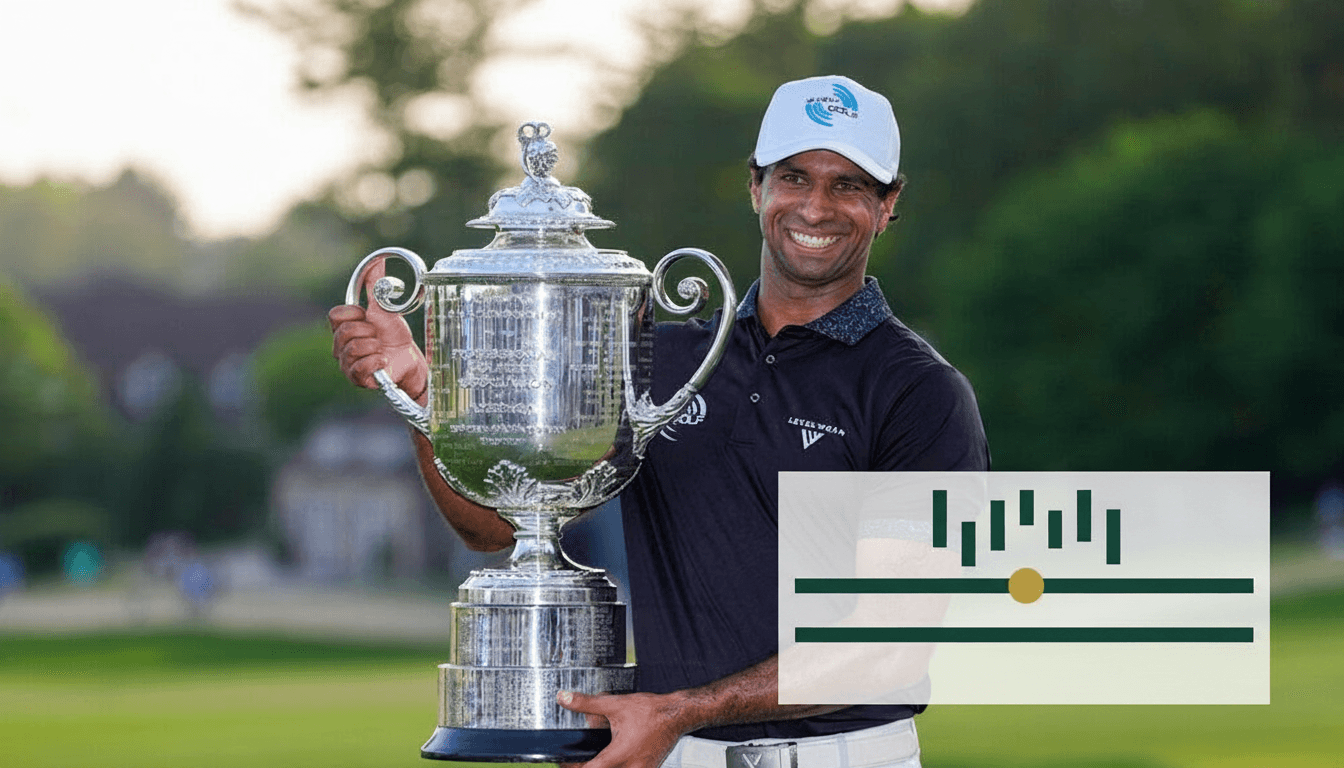
Aaron Rai shot a final-round 65 at Aronimink on Sunday to win the 2026 PGA Championship, ending England's 107-year wait for a major. He claimed the Wanamaker Trophy despite three front-nine bogeys, manoeuvring a congested leaderboard with remarkable composure. What's striking isn't just the scorecard — it's that he barely glanced at the leaderboard all day. If you want to understand exactly how he pulled that off, stick around.
What Aaron Rai Did at Aronimink on Sunday
When Aaron Rai walked off Aronimink on Sunday evening with a 65 and the Wanamaker Trophy, the detail that separated his win from routine major coverage wasn't the scoreline — it was what he chose not to do.
Three bogeys on the front nine, a congested leaderboard, 107 years without an English major winner — the pressure context was real. Yet across Aaron Rai's final round, he refused to check the leaderboard. He gave his attention a specific task: playing the golf course. His single execution cue was "trust the strike." As he put it: "I didn't look too much at the leaderboard." That deliberate narrowing of focus reflects the mental operating system the article will work through — one swing thought reduces cognitive load and keeps performance anchored to execution rather than outcome.
The Architecture Underneath the Leaderboard Discipline
What made Sunday's leaderboard discipline possible was not built on Sunday. Rai's father designed his junior pathway decades earlier, and three structural elements compounded over time.
First, the forward-tees development. Rai played from customised fairway distances until age 12, configured so he could shoot par or better at every stage. The principle was simple — make scoring a habit rather than an aspiration. By the time he could play from full tees, the identity was already built. He was a scorer, not a chaser of distance.
Second, the deliberate isolation from standard junior club circuits. Rai did not enter the general club junior tournament scene. His father kept him in age-specific competition only, away from the peer culture that tells young golfers what is "normal". He developed his unconventional habits — two gloves, iron covers, a scoring-first focus — without ever being told they were unconventional. By the time he was exposed to the wider golfing world, he had a full system and understood exactly why each element existed.
Third, the continuity of his coaching relationships. His coaches have been with him since childhood. The structural value of that continuity is not the technical instruction itself — it is that the system Rai trusts on Sunday is the same system that has been tested, refined, and validated for two decades. The synthesis of these three is what mental performance under pressure actually requires. Not willpower applied in the moment, but identity established long before the moment arrives. Process-over-outcome golf is not a Sunday decision for Rai. It is the only system he has ever known.
Rai's discipline at Aronimink is also the fifth named example in 2026 of an elite player filtering external inputs during competition. Nelly Korda did it at the Chevron Championship. Rory McIlroy did it at the Masters. Matt Fitzpatrick did it at the RBC Heritage. Jon Rahm did it at the PGA Championship Round 3. Five players, five events. But Rai is structurally different from the other four in one way worth naming — they exercised discipline under pressure. He operated from an identity that made the discipline natural. The distinction is what this win surfaces.
What This Means for Your Game
That structural clarity Rai operates from isn't available off the shelf — and the gap between his situation and yours is worth being honest about before drawing any practical lessons. He had lifelong coaches, a privately designed pathway, and decades of reinforced identity underneath Sunday's discipline. You almost certainly didn't.
The practical implication is that ignoring the leaderboard golf advice without that foundation is half a prescription. Most amateur process-focused attempts collapse because there's nothing solid to fall back on. The real task isn't copying Rai's protocol — it's building structural clarity deliberately, in adulthood, starting now. Research in sports psychology for golf shows that translating academic mental performance principles into on-course frameworks requires deliberate scaffolding rather than borrowed routines.
Next Upgrade — Building the Two Layers
Building the two layers Rai operates from takes deliberate work, but the sequence is straightforward. Like the 2026 PGA Championship winner, you need structural identity before leaderboard discipline becomes possible. Follow this order:
Building two layers takes deliberate work, but the sequence is straightforward — structural identity before leaderboard discipline becomes possible.
- Write down one thing you do differently from most golfers, and explain why— if you can't answer that, close the gap first
- Commit to one execution cue before your next round — process-based, not outcome-based
- Let that cue replace scoreboard awareness during play
- After the round, debrief the cue and your routine, not the score
For more on building the routine layer that supports an execution cue, see the Thought Architecture hub.
Try it free
Ready to organise your mental game?
Capture your swing thoughts, set your focus, and play with clarity.


Related reading
Cognitive Load in Golf: How Amateurs Can Think Less and Play Better
Carrying three swing thoughts to the ball is one of the most common amateur mistakes. This is how to filter inputs, protect working memory, and swing with one clear thought.
What the 2026 Masters Taught Us About Pressure, Belief, and the Mental Game of Golf
The 2026 Masters was decided by mental systems, not ball-striking. What McIlroy's evolving targets, Rose's indecision at Amen Corner, Young's Sunday collapse, and Scheffler's bogey-free weekend reveal about building mental architecture that holds under real pressure.
What Rory McIlroy, Patrick Reed and Tommy Fleetwood Revealed About Their Mental Game After Round 2 at the 2026 Masters
Three players, three mental systems, one Masters leaderboard. What McIlroy's mantra, Reed's conviction architecture and Fleetwood's discipline protocol reveal about building a mental operating system that works under pressure.