
Sports Psychology for Golf: Translating the Science to the Fairway
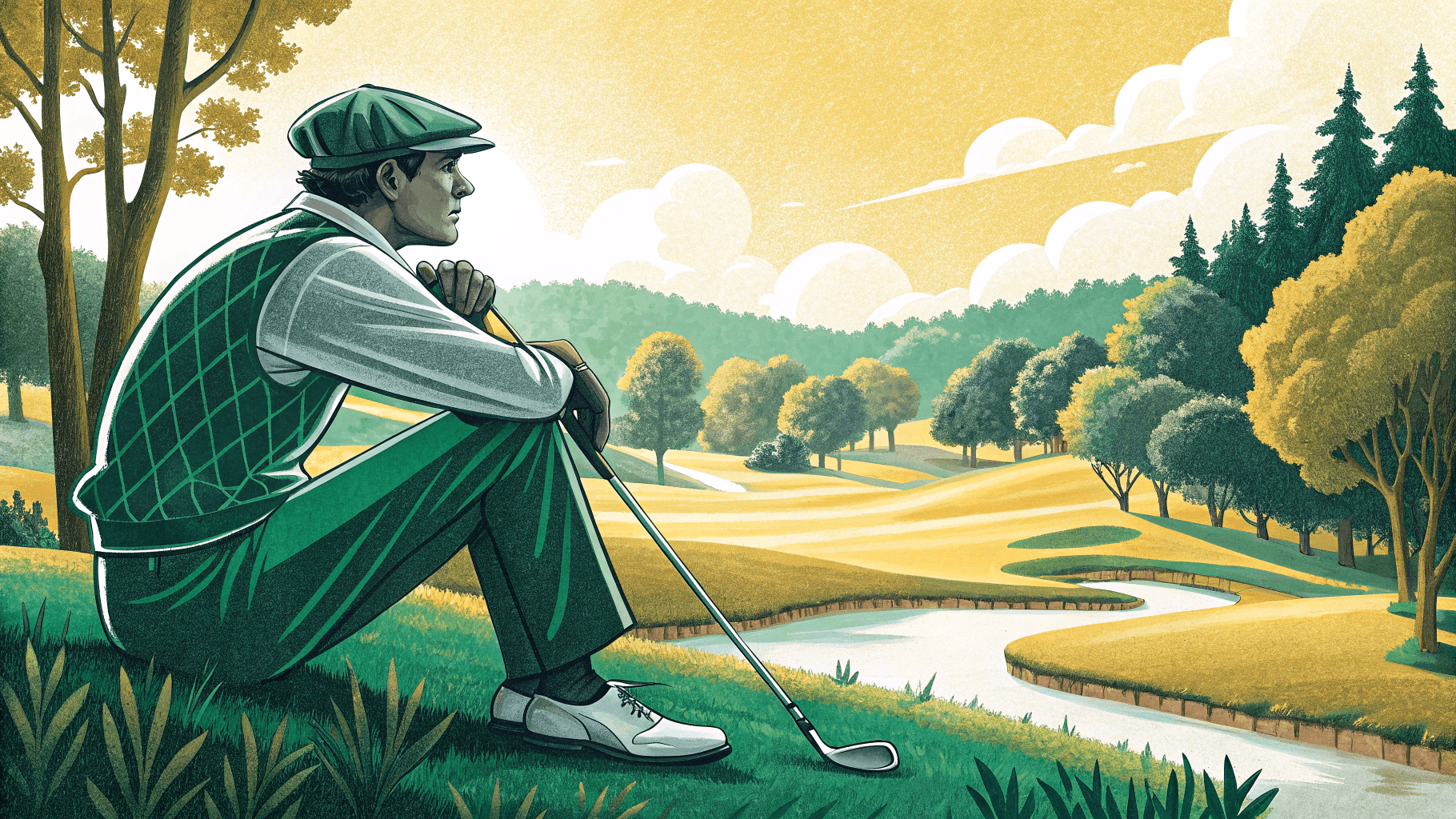
Sports psychology for golf shows that your emotions and scores shape each other in a continuous loop. A bad hole doesn't just cost you a stroke — it raises your tension and irritability, which quietly influence your next swing before you've even teed up. Skilled golfers break this cycle faster, and handicap determines how much it costs you when you don't. The science behind why goes deeper than most golfers ever realise.
How Past Performance on Each Hole Shapes Your Emotional State
When you step off a hole having just made a bogey or worse, your body doesn't simply reset — it carries that frustration forward.
Your body doesn't reset after a bad hole — it carries that frustration forward into every shot that follows.
Research in sports psychology for golf confirms that poor performance on a hole directly predicts increased tension and irritability on subsequent holes.
Your emotional state isn't random; it's shaped by what just happened.
Sport psychology golf studies show tension builds on itself, meaning one bad hole can snowball into emotional interference that disrupts your swing mechanics and decision-making.
However, when channelled correctly, irritability can actually sharpen your focus.
Understanding golf sports psychology means recognising these patterns within yourself.
Tour professionals develop deliberate pressure thought management routines between holes to prevent compounding emotional interference.
Skilled players limit how much negative emotion bleeds into performance.
Lower-handicap awareness of these emotional cycles gives you a measurable competitive edge on every hole.
The Emotion-to-Score Feedback Loop Most Golfers Don't See
Most golfers track their scorecard but miss the invisible cycle driving it: your score shapes your emotions, which then shape your next score. A poor hole raises tension and irritability, and those emotions directly influence how you perform on the next hole. Research confirms this loop is real and measurable.
Here's what's counterintuitive: irritability after a bad hole can actually predict a better next score, while tension tends to compound and persist. Your emotional response isn't random—it follows a pattern tied to your performance history.
Skilled golfers break this cycle by limiting how much negative emotion bleeds into the next shot. They don't suppress feelings; they manage them strategically. Understanding the loop means you're no longer its victim—you're steering it consciously. One proven method for building this skill before competition is pressure inoculation training, which exposes golfers to stress in practice. Hence, the nervous system learns to perform under it rather than collapse.
The Skill Gap: Why Handicap Determines How Much Emotions Cost You
Your handicap doesn't just measure your ball-striking—it determines how much your emotions cost you on the scorecard. Research confirms that higher handicaps predict both poorer scores and stronger score-to-score carryover effects.
In other words, one bad hole snowballs harder for you than it does for a scratch golfer.
Here's why: skilled players report significantly less irritation after poor holes. They've trained themselves to interrupt the emotional feedback loop before it compounds.
You haven't—yet.
That gap isn't purely technical. It's psychological.
When negative affect runs unchecked, it amplifies scoring mistakes across consecutive holes.
Your handicap essentially measures your current vulnerability to that cycle.
Tour players and sports psychologists widely estimate that golf is 50-90% mental, with the mental component weighing more heavily as technical skills improve and competitive pressure increases.
Closing the skill gap means learning to manage emotions as deliberately as you manage your club selection.
Irritability vs Tension: How Each Emotion Changes Your Score Differently
Not all negative emotions damage your game the same way. Research separates irritability and tension into distinct forces that affect your score differently.
Tension hurts you. It compounds itself hole after hole, building psychological pressure that disrupts execution and raises your score.
Once tension takes hold, it sustains itself, making each subsequent hole harder to navigate cleanly.
Irritability, surprisingly, works differently. Feeling irritated after a poor hole actually predicts better performance on the next one.
That edge, when channelled rather than suppressed, can sharpen your focus and drive correction.
Skilled players understand this distinction intuitively. They let irritability motivate without letting tension accumulate.
You can apply the same principle by recognising which emotion you're feeling and responding accordingly, rather than treating all negative affect as equally destructive. Using external attention cues under pressure can help redirect either emotion toward productive focus rather than internal rumination.
What Skilled Golfers Do Differently Between Holes
Knowing which emotion you're feeling is only half the battle—skilled golfers also respond to those emotions differently than higher-handicap players do.
After a poor hole, skilled players report significantly less irritation than higher-handicap golfers do. That emotional restraint matters because it prevents negative feelings from compounding across holes.
Skilled golfers feel less irritation after a bad hole—and that restraint stops negative emotions from snowballing.
If your handicap is higher, you're more vulnerable to letting emotions shape your next shot. Your score is more likely to carry forward through auto-regression, meaning a bad hole predicts another bad hole partly through the emotional chain it triggers.
Skilled golfers break that chain by limiting how much negative affect bleeds into subsequent performance. Structured bounce-back protocols give you a repeatable process for resetting after a poor hole rather than relying on willpower alone. You can develop this same capacity through focused mental skills training—specifically emotional control, resilience, and present-moment focus between holes.
Why Coping Follows Performance, Not the Reverse
When you hit a poor shot, your coping strategies don't drive your next performance—your performance drives your coping.
Research confirms that negative affect, like tension and irritability, follows your scores, not the other way around, meaning you're reacting emotionally to outcomes rather than shaping them through emotional management.
Your skill level moderates this cycle, as higher-handicap golfers experience stronger negative emotional responses after poor holes, while skilled players keep that emotional fallout in check.
Performance Drives Coping Reactions
Although it might seem intuitive that coping strategies drive performance, research flips this assumption on its head: your performance on the previous hole predicts how you cope, not the other way around. When you bogey a hole, your coping response follows that outcome rather than shaping it.
This distinction matters practically. You can't, through coping alone, mentally strategise your way out of a bad shot before it happens.
Instead, your brain processes what just occurred, then generates a coping reaction. Negative affect, perceived control, and coping behaviours show minimal predictive power over your next hole's score.
What this means for your game: focus less on rehearsing coping strategies in isolation and more on understanding how your emotional responses to outcomes naturally unfold, hole by hole.
Skill Moderates Emotional Response
Skill level shapes how strongly your emotions respond to a bad hole—and that changes everything about the coping picture. Higher-handicap golfers experience stronger negative emotional reactions, which compounds their performance struggles. Skilled players regulate those reactions more efficiently, limiting the emotional fallout before it affects the next shot.
Research confirms three skill-related patterns:
- Skilled golfers report less irritation after poor holes (β = –.67), keeping emotions from snowballing.
- Higher handicap predicts worse scores (β = .71) and stronger score auto-regression, creating a compounding cycle.
- Lower skill amplifies the influence of negative affect, making emotional management more urgent—not optional.
You can't separate your skill development from your emotional development. As your game improves, your emotional responses naturally stabilise, making coping strategies far more effective.
Negative Affect Follows Scores
Most golfers assume that managing emotions leads to better scores—but the research flips that assumption.
Your performance on a given hole actually drives your emotional state on the next one, not the other way around.
Negative affect, your sense of control, and your coping responses show minimal ability to predict your next score.
Instead, how you scored predicts how you'll feel.
This means coping reactions follow performance rather than shape it.
You're not cooling down before a bad shot—you're reacting after one.
Understanding this shift matters because it changes where you direct your mental energy.
Rather than trying to suppress emotions before a hole, focus on executing each shot well.
Better performance naturally limits the negative effect you’ll need to manage afterwards.
How Focus, Confidence, and Resilience Protect Your Golf Game Under Pressure
When pressure mounts on the course, three mental skills determine whether you hold it together or unravel: focus, confidence, and resilience.
Each skill targets a specific vulnerability in your game:
- Focus keeps you anchored in the present shot, preventing past mistakes or future holes from hijacking your attention.
- Confidence lets you trust your trained swing without second-guessing mechanics mid-round, especially after a poor hole.
- Resilience enables quick emotional recovery, limiting how long negative affect disrupts your subsequent performance.
Research confirms that skilled players restrict negative emotions from bleeding into next-hole scores. These three skills are precisely how they do it.
You don't eliminate pressure—you build the mental infrastructure to perform through it.
The Mental Habits That Stop One Bad Golf Shot Becoming Three
When you make a bad shot, your emotional response can trigger a cascade that turns one mistake into several consecutive poor holes.
Research shows that skilled golfers actively interrupt this cycle by resetting their emotional state before the next shot, preventing irritation and tension from compounding their scores.
You can adopt the same habit by recognising the early signs of an emotional snowball and using focused mental cues to neutralise negative affect before it shapes your next decision.
Recognising Emotional Snowball Effects
One bad shot rarely derails a round on its own—your reaction to it does. Research confirms that poor performance predicts rising tension and irritability, which then compounds your next result.
Skilled players break this cycle faster because they've trained their emotional responses, not just their swings.
Here's what the snowball looks like in motion:
- A poor shot triggers tension and irritability
- Unmanaged negative emotion influences your next swing decision
- Another poor result reinforces the emotional spiral
Recognising this pattern is your first defence. When you notice frustration building, you're catching the snowball before it grows.
Tension carries momentum—it auto-regresses, meaning yesterday's stress feeds tomorrow's. Understanding the mechanism gives you the awareness to interrupt it before one bad hole becomes three.
Resilience Resets Your Next Shot
Recognising the snowball is half the battle—stopping it's where resilience comes in. Resilience isn't about pretending a bad shot didn't happen; it's about recovering quickly enough that the next shot doesn't suffer for it.
Research confirms that skilled golfers limit how much negative emotion bleeds into subsequent performance—they reset faster and more completely.
You can train this. After a poor hole, acknowledge the frustration briefly, then redirect your attention to the next shot's specific demands.
Visualisation helps here—mentally rehearsing the upcoming shot primes your brain for execution rather than rumination.
Focus pulls you into the present, emotional control keeps you neutral, and confidence reminds you your swing still works.
Resilience isn't talent; it's a practiced habit you build deliberately.
Skilled Players Limit Negative Affect
What separates skilled golfers from high-handicappers isn't just technique—it's how quickly they cut off the emotional feedback loop after a bad shot. Research confirms that skilled players experience significantly less irritation following poor holes, limiting how much negative emotion bleeds into the next shot.
Higher handicaps correlate directly with stronger emotional reactions and worse subsequent scores. You're not just fighting the course—you're fighting yourself.
Skilled players protect their game through three habits:
- Recognising the emotional spike without acting on it
- Reframing the bad shot as data, not failure
- Redirecting focus immediately toward the next execution
Your skill level shapes how emotion affects performance. Developing emotional regulation isn't optional—it's what prevents one bad shot from becoming three.
Why Visualisation Before a Golf Shot Is Neural Prep, Not Wishful Thinking
When you picture a golf shot before you take it, your brain doesn't treat that image as fantasy — it treats it as rehearsal. The same neural pathways that fire during physical execution activate during vivid mental imagery. You're essentially pre-loading the movement pattern before your body performs it.
This matters because execution under pressure depends on automated, practiced responses. When you visualise the ball's flight path, your intended landing zone, and your swing shape, you're giving your nervous system a blueprint to follow.
Doubt and mechanical overthinking shrink when a clear image already exists.
Visualisation isn't confidence-boosting self-talk. It's functional preparation — priming your motor system for a specific outcome before you ever address the ball.
What Neurotechnology Actually Adds to Golf Psychology
Visualisation primes your brain, but neurotechnology takes that process further by giving you real-time data on what's actually happening inside it. Tools like EEG headsets and biofeedback devices measure your mental state during practice, showing you exactly when focus sharpens or anxiety spikes.
That feedback makes sports psychology more precise. You're not guessing whether your emotional control is working — you're seeing it confirmed.
Here's what neurotechnology practically delivers:
- Real-time awareness — you identify mental drift before it disrupts your swing
- Distraction reduction — you train your attention to filter course noise more efficiently
- Psychological skill validation — you confirm which mental techniques actually shift your brain state
The result is a tighter loop between mental training and measurable performance improvement.
Why Your Golfer Identity Determines Whether You Keep Improving
How you see yourself as a golfer shapes every decision you make on the course, from how hard you practice to whether you push through a rough stretch or quit.
Research confirms that your athletic performance, physical presence, and moral image directly fuel your desire to keep competing and improving.
When you build a strong golfer identity, you're not just protecting your confidence—you're creating the psychological foundation that sustains long-term commitment and growth.
Identity Shapes Your Game
Your golfer identity shapes every decision you make on the course — from how you respond to a bad shot to whether you keep showing up to practice when results feel slow. How you see yourself as a golfer directly influences your emotional reactions, coping strategies, and long-term commitment.
Research confirms that skill level moderates the effect of negative emotions on performance. Skilled players limit that influence — and identity drives skill development.
Three ways identity shapes your game:
- Resilience — You recover faster from mistakes when you see yourself as capable
- Consistency — Strong identity keeps practice habits intact despite setbacks
- Emotional control — Believing you're a golfer sustains neutral, focused states under pressure
Your identity isn't fixed — you build it through deliberate action.
Self-Image Drives Commitment
The image you hold of yourself as a golfer determines how long you stay in the game. Research confirms that three image dimensions—performance ability, physical appearance, and moral character—directly shape your desire to keep participating.
When you see yourself as capable and improving, you develop stronger cognitive and behavioural commitment to the sport. That commitment translates into continued practice, course time, and skill development.
Here's what's worth noting: cognitive and behavioural desire drive continuation, while affective desire alone doesn't. Feeling excited about golf isn't enough. You must think of yourself as a golfer and consistently act like one.
Build your identity deliberately. The golfer who invests in self-image invests in longevity—and longevity is where real improvement lives.
Perception Fuels Improvement
What you believe about yourself as a golfer shapes every decision you make on the course—how often you practice, whether you seek coaching, and how quickly you bounce back from a bad round.
Research confirms that how you perceive a golfer's image directly influences your desire to participate and improve.
Three interconnected factors drive this:
- Performance ability — Believing you're capable pushes you to practice deliberately.
- Physical appearance — Feeling athletic reinforces your golfer identity.
- Moral image — Respecting the game deepens your commitment to it.
These perceptions trigger cognitive and behavioural responses that sustain participation.
Simply put, if you see yourself as a golfer, you act like one—and that identity becomes the engine behind continuous improvement.
References
- https://pmc.ncbi.nlm.nih.gov/articles/PMC8267075/
- https://www.frontiersin.org/journals/psychology/articles/10.3389/fpsyg.2025.1500592/full
- https://www.neurotrackerx.com/post/why-golf-performance-is-90-mental
- https://www.youtube.com/watch?v=sW-nN2W9bzo
- https://pmc.ncbi.nlm.nih.gov/articles/PMC4647149/
- https://www.bps.org.uk/psychologist/five-inch-course
- https://www.sport-excellence.co.uk/how-much-of-golf-is-psychological/
Try it free
Ready to organise your mental game?
Capture your swing thoughts, set your focus, and play with clarity.


Related reading
Aaron Rai's Final Round at the 2026 PGA Championship
Aaron Rai won the 2026 PGA Championship with two layers of mental architecture working together: Sunday leaderboard discipline and a structural identity built over decades.
Cognitive Load in Golf: How Amateurs Can Think Less and Play Better
Carrying three swing thoughts to the ball is one of the most common amateur mistakes. This is how to filter inputs, protect working memory, and swing with one clear thought.
What the 2026 Masters Taught Us About Pressure, Belief, and the Mental Game of Golf
The 2026 Masters was decided by mental systems, not ball-striking. What McIlroy's evolving targets, Rose's indecision at Amen Corner, Young's Sunday collapse, and Scheffler's bogey-free weekend reveal about building mental architecture that holds under real pressure.