
Justin Thomas's Reaction to the Pace Warning at the 2026 PGA Championship
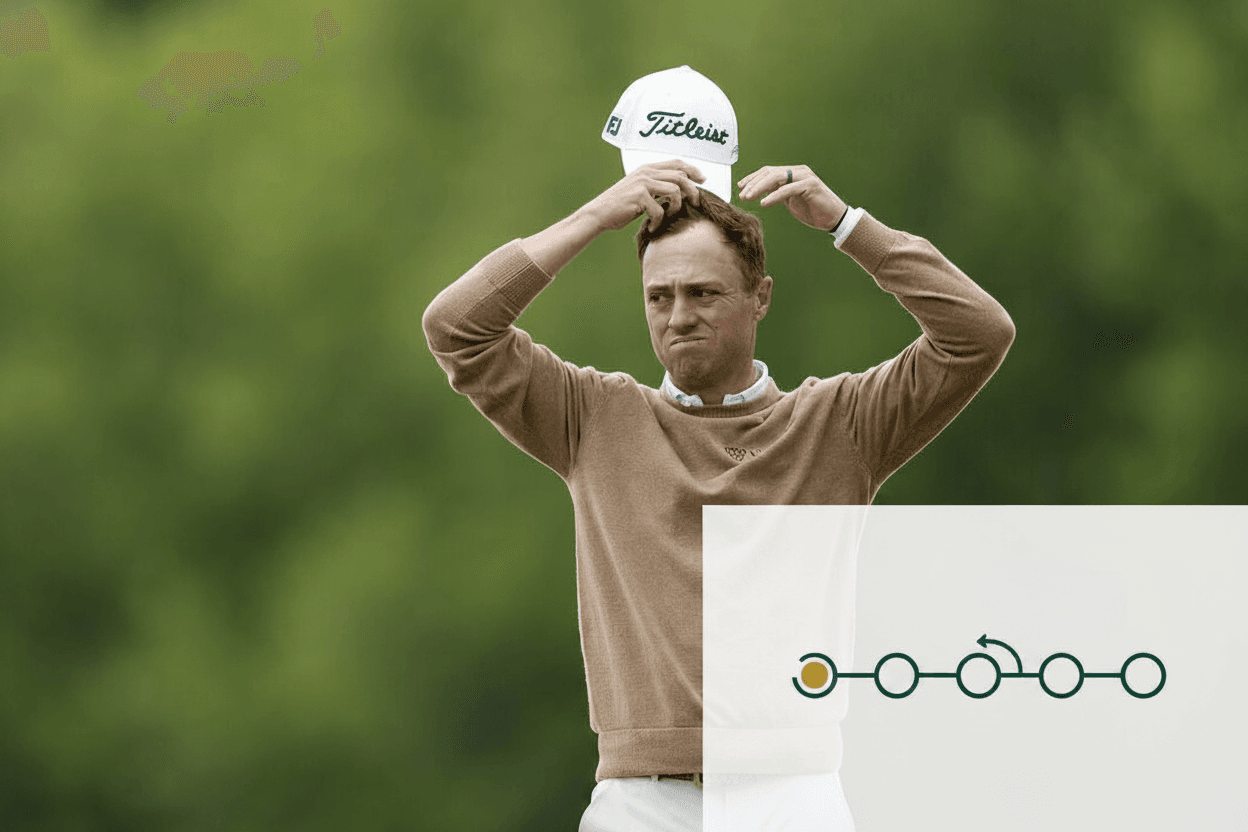
Justin Thomas's Reaction to the Pace Warning at the 2026 PGA Championship
At the 2026 PGA Championship at Aronimink, a rules official put Justin Thomas on the clock during round two, and the tense exchange that followed was caught on camera. But what happened next told the real story. Thomas entered his pre-shot routine, felt something wasn't right mid-sequence, and stepped completely away before starting over. It wasn't hesitation — it was a deliberate mental reset, and understanding why it works is the lesson worth taking from this round.
What Happened on Justin Thomas's Pace Warning
During the second round of the 2026 PGA Championship at Aronimink Golf Club, a rules official placed Justin Thomas on the clock for slow play — and the exchange that followed was, by most accounts, tense.
But the real story isn't the warning.
What Thomas did next: he entered his pre-shot routine, addressed the ball, then stepped away before pulling the trigger.
He addressed the ball, felt it wasn't right, stepped away, and started over completely.
He reset completely and re-entered from the start.
Thomas was open about his thinking afterwards. He disputed the warning itself — arguing the group was not holding up the players behind them, and noting the group was taken off the clock a hole later when they had caught up. But on the next shot, he refused to let the warning rush him: "The last thing I'm going to do is rush". The back-off and reset was deliberate.
What happened on that next shot is the part worth studying.
The Reset Inside a Tour Pro's Sequence
What Thomas did after stepping away wasn't a lapse — it was the sequence functioning exactly as it's designed to. The Justin Thomas PGA Championship 2026 moment that cameras caught wasn't hesitation. It was a deliberate reset of the sequence. Each phase exists for a reason:
- Commit — lock onto the target, no ambiguity
- Rehearse — feel the movement before it counts
- Trigger — signal your body that execution begins
- Execute — let the trained movement run without interference
Disturb any phase, and forcing through creates conscious override. Stepping away protects all four. Tour pros also understand that carrying too many swing thoughts into execution raises cognitive load to a level that undermines the very automation the routine is meant to protect.
Why Stepping Away Is Not the Same as Slowing Down
The criticism writes itself: he was already on the clock, and then he stopped.
But here's the distinction that matters.
There are two different players in this scenario — one who hasn't started yet, and one who's mid-sequence and just been interrupted. The first is slow. The second is correct.
The Justin Thomas pace warning exposed that gap publicly. His step-away wasn't added time; it was the right response to a disturbed state.
Your approach to the ball isn't a countdown — it's a structured sequence with a built-in exit.
Firing through disruption doesn't save time — it costs you the shot.
Tour pros know that resetting after an interruption means returning to a neutral mental state before restarting the sequence, because committing to the shot is impossible when the mind is still processing the disturbance.
Next Upgrade — Building the Reset Into Your Sequence
Most golfers build a sequence and then leave the reset out of it entirely — which means the first time they're interrupted mid-approach, they've no sanctioned response.
PGA Championship 2026 Round 2 showed you what a complete sequence looks like under pressure.
- Define your trigger explicitly — you need a clear commit point.
- Identify which phases precede it: commitment, rehearsal, address.
- Grant yourself permission to step away if any phase is disturbed.
- Re-enter at the beginning — never patch in from the middle.
Your sequence isn't complete until the reset is built in. A structured pre-round warm-up protocol that incorporates mental rehearsal alongside physical preparation gives you a proven framework to rehearse that resets before you ever reach the first tee.
Try it free
Ready to organise your mental game?
Capture your swing thoughts, set your focus, and play with clarity.


Related reading
Aaron Rai's Final Round at the 2026 PGA Championship
Aaron Rai won the 2026 PGA Championship with two layers of mental architecture working together: Sunday leaderboard discipline and a structural identity built over decades.
Jon Rahm's Strategy for External Noise at the 2026 PGA Championship
Jon Rahm shelved LIV funding news until after his round at the 2026 PGA Championship. The information discipline that protects a Tour pro's competitive state.
Rory McIlroy's Final Four Holes at Aronimink in the 2026 PGA Championship
Rory McIlroy ended his opening round at Aronimink with four straight bogeys after trying to manually fix his driver. What happens when conscious control replaces trained instinct?