
Building Your Pre-Shot Routine: The Architecture of Consistent Golf
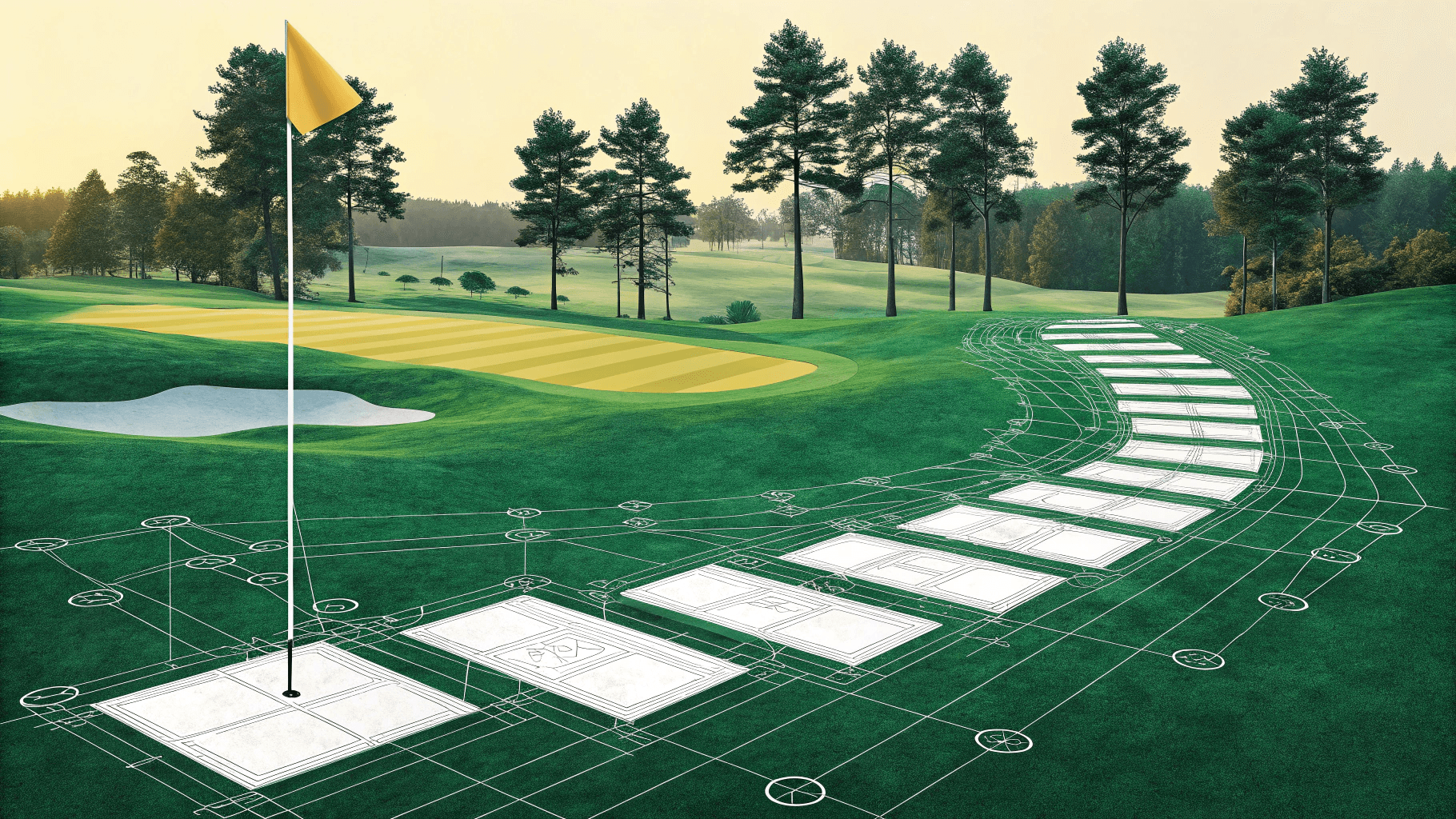
A pre-shot routine is a structured four-phase protocol—commitment, rehearsal, trigger, execution—that builds confidence by loading one active thought before your club moves. It's not just a warm-up habit; it's your mental foundation for consistent performance.
Key Takeaways
- A pre-shot routine is a structured four-phase protocol—commitment, rehearsal, trigger, execution—not a casual warm-up habit before each shot.
- The entire routine should take 22 to 28 seconds, and maintaining consistent timing is crucial for reliable performance.
- During commitment, lock onto a specific target and one-shot shape within three seconds, using first-person visualisation at real-time speed.
- Carry only one external focus cue into execution—research shows zero tour players report mechanical thoughts during the swing itself.
- A consistent physical trigger, such as a waggle or a forward press, signals the brain to stop planning and start executing within 3 seconds.
What Is a Pre-Shot Routine and Why Does It Matter More Than Your Swing?
Your pre-shot routine isn't just a warm-up — it's the core interface of your mental operating system, guiding focus, reducing tension, and ensuring full commitment before the club moves.
Research identifies it as the single most effective mental intervention in golf, outperforming any swing change in terms of consistency under pressure.
Skip it when the heat's on, and you'll watch your decision-making fragment — because without that interface running, there's no system governing what your mind does between "I need this shot" and the moment of contact.
Performed consistently, the pre-shot routine also functions as a pressure inoculation tool, helping your nervous system stay calm and focused whether you're on the practice range or facing a tournament-deciding shot.
The Routine Is the Interface, Not the Swing
While most golfers treat their pre-shot routine as a mechanical checklist — align the clubface, set the feet, check ball position — the routine's real function runs deeper than any of that.
A solid pre-shot routine is the interface between your conscious decisions and your body's trained responses. It's the delivery mechanism for your Active Thought — the single conscious input your mind carries into the swing.
Think of your pre-shot routine before every shot as a boot sequence:
- Select: Lock onto a target in your mind and commit to one-shot shape.
- Load: Visualise the ball flight, priming your motor system.
- Launch: Take one last look, then let the subconscious execute.
The routine isn't preparation for the swing. It is the swing's operating system.
What Happens When You Skip It Under Pressure
Nearly every golfer has felt it — standing over a critical putt or a tight tee shot and rushing straight into the swing because the moment feels too big to slow down. That rush isn't courage. It's collapsed.
When you skip your routine, your mental operating system loses its boot sequence. Without the familiar steps before every shot, your brain defaults to its threat response — scanning for danger, consciously monitoring mechanics, flooding working memory with competing instructions.
Psychologists call this reinvestment: the nervous system, lacking a conditioned safety signal, stays in fight-or-flight mode.
The routine is the safety signal. It reassures your brain that the environment is familiar and your process is reliable, helping you feel more secure and fully committed to each shot.
The Anatomy of a Tour-Level Pre-Shot Routine
Every tour-level routine, no matter how different it looks on the surface, runs through four distinct cognitive phases: commitment, rehearsal, trigger, and execution.
You'll find these phases in Morikawa's work with Sessinghaus just as clearly as in a club amateur's best rounds — the structure is universal, even if the content differs.
Understanding what each phase does and how long the entire sequence should take gives you the blueprint for building a routine that holds up under pressure.
Research supports keeping your focus narrow during execution, with many players relying on external attention cues rather than internal mechanical thoughts to maintain consistency under pressure.
The Four Phases Every Elite Routine Contains
When you strip away individual quirks — the glove adjustments, the club twirls, the trademark tugs at a shirt sleeve — every elite pre-shot routine runs through the same four-phase architecture: Commitment, Rehearsal, Trigger, Execution.
- Commitment — you select your club, pick a specific target (not a vague direction), and decide on one shot shape. Every single decision locks in here.
- Rehearsal — a practice swing matching your intended tempo, or a PETTLEP visualisation of the flight. This isn't a mechanical check; it's a dress rehearsal.
- Trigger — a consistent physical action — a waggle, a forward press, a breath — that signals your brain to stop planning and start executing.
Execution follows within three seconds. You run this sequence before every shot to build consistent golf through repeatable architecture.
How Long Should Your Pre-Shot Routine Actually Take?
Shot-to-shot timing variance is the strongest predictor of performance breakdown — stronger than the routine's content itself.
If your pre-shot routine takes 22 seconds on the range but stretches to 35 on the first tee, the routine has already collapsed before you've swung.
Your target isn't a perfect number. It's a narrow band you can reproduce under pressure, hole after hole, regardless of the situation.
Your putting green routine follows the same timing discipline — a consistent pre-putt process that eliminates the hesitation responsible for most three-putts.
Why Timing Consistency Predicts Performance Better Than Technique
Most golfers blame a missed shot on their swing, but research points to a different culprit — the clock.
Studies show that when your pre-shot routine varies by five or more seconds between shots, you're statistically more likely to miss than a golfer with consistent timing, regardless of swing quality.
That variance signals your mental operating system isn't running its standard boot sequence, and you can measure it yourself with nothing more than a phone stopwatch and honest record-keeping.
Sports psychologists estimate that golf is 90% mental, particularly once a player has developed a reliable physical swing.
Duration Variance and Its Direct Link to Scoring
Timing reveals what technique alone cannot. When your routine duration stays consistent, your scoring tightens across rounds. When it drifts, shots deteriorate — often before you consciously notice anything wrong.
Duration variance is the metric that exposes mental disruption early. A routine that normally takes 18 seconds but suddenly stretches to 24 seconds signals doubt creeping in, and doubt leads to poor commits.
- Tight variation in routine length correlates with the lowest scoring variance among tour professionals
- Spikes in duration predict shot-quality drops before they appear on the scorecard
- ClarityCaddie's round mode tracks your timing passively, alerting you when duration variance exceeds your normal pattern
You don't need a perfect swing. You need a consistent clock running underneath every shot you hit.
How to Measure Your Own Routine Timing
Before you can tighten your routine, you need a number to work from — and gathering it requires nothing more than a playing partner with a stopwatch or your phone's timer running during a casual round. Start timing from the moment you stand behind the ball to the swing initiation.
Record 10–15 shots per round.
Calculate your average duration and standard deviation. If that deviation exceeds three seconds, your routine isn't conditioned yet — building one that holds under pressure demands tighter variance.
For anyone looking to play with genuine consistency, keep it simple: measure first, intervene second. Whether your final focus lands on a blade of grass or a distant target, the clock reveals what feel cannot.
This baseline becomes your architectural blueprint for every session that follows.
The One Active Thought Rule: Loading Your Mental Trigger
Your routine has funnelled attention from broad strategy to a single moment of commitment — now you need to load the right thought into that moment.
The One Active Thought rule is ClarityCaddie's core design principle: one thought fires at trigger, everything else stays in the Thought Locker.
Research consistently shows that a single external focus outperforms stacked internal cues, and understanding why changes how you build every pre-shot sequence from this point forward. This principle works because a golfer's performance is directly governed by cognitive load reduction, where fewer competing thoughts allow the subconscious motor system to execute freely.
Why One Thought Outperforms Three Every Time
When a survey of 24 PGA Tour players asked what they thought about during the swing, 18 reported nothing at all — and the remaining six focused on a single external spot, such as a point inches ahead of the ball. No mechanical cues were reported during execution.
Under pressure, your working memory reliably holds one to two chunks. Loading 3 thoughts doesn't sharpen execution — it causes paralysis.
- One thought keeps your pre-shot routine clean and your swing free
- Two thoughts split attention and delay commitment to a specific target
- Three thoughts exceed cognitive capacity every time, producing hesitation
For anyone looking to play consistent golf, the evidence is unambiguous: fewer thoughts produce freer movement and lower scores. The same minimalist approach applies to driver swing thoughts — one cue, fully committed, with everything else silenced before takeaway.
External Focus vs Internal Focus: The Research
This distinction matters for every golfer looking to play better, not just elites. A survey of 24 PGA Tour players found 18 reported zero conscious swing thoughts mid-execution — and the remaining six focused externally, on a spot just ahead of the ball.
Nobody was monitoring wrist angles. Your single active thought should describe where the club goes or what it does — never how your body moves.
How to Design Your Pre-Shot Routine From Scratch
The balance between these phases depends on your playing personality — whether you're a deliberate planner who needs more time behind the ball or a reactive feel player who commits quickly and trusts setup instincts.
Start by identifying which phase currently leaks the most doubt, then build your framework from that point outward using the trigger-first method outlined below. A consistent pre-shot routine also strengthens your pressure resilience by giving you a repeatable process to return to when high-stakes moments threaten to disrupt your focus and execution.
From Behind the Ball to Over the Ball
Every effective pre-shot routine moves through four distinct phases — and the entire sequence should take no longer than 22 to 28 seconds from start to finish.
- Phase 1 — Target lock: Stand behind the ball and commit to a specific target within a three-second window. This is where you visualise the shot shape and flight path using first-person imagery at real-time speed.
- Phase 2 — Tempo rehearsal: Take one practice swing that matches your intended tempo. This isn't a mechanical drill — it's a feel-based primer for rhythm.
- Phase 3 — Set and go: Step into your stance, waggle twice, and initiate the swing within three seconds: no extra movements, no second-guessing.
- Phase 4 is execution — you've already made every decision. Now you swing.
Before any of this begins, a structured warm-up routine primes both your body and your mental operating system for the round ahead.
Matching Your Routine to Your Playing Personality
A four-phase framework gives you the skeleton — but the muscles you attach to it depend entirely on how your mind behaves under pressure.
If you're a high-reinvestment golfer — someone whose mind races toward mechanical monitoring mid-swing — you'll need stronger physical triggers.
A deliberate waggle, a forward press, or a grip reset gives your conscious mind something tangible to latch onto, preventing it from hijacking your swing with technical chatter.
If you're a low-reinvestment golfer, quieter triggers work better.
A single breath, a visual lock on your target line, or a gentle exhale before takeaway keeps your already-calm processing undisturbed.
ClarityCaddie's calibration engine measures where you sit on this spectrum and recommends routine adjustments matched to your actual tendencies — not a generic checklist borrowed from someone else's brain.
The PETTLEP Model: Why Your Mental Rehearsal Probably Isn't Working
Most golfers get visualisation wrong because they watch themselves swing from a camera angle that doesn't exist during play, at a speed that bears no resemblance to reality, in a mental setting stripped of any competitive texture.
The PETTLEP model — Physical, Environment, Task, Timing, Learning, Emotion, Perspective — identifies seven elements your mental rehearsal must satisfy before it actually transfers to performance.
The three non-negotiables are first-person perspective, real-time speed, and practising in the environment where you'll compete. Pairing this rehearsal with a single, well-chosen swing thought also reduces cognitive load in golf, keeping your mental rehearsal clean and actionable rather than cluttered with competing technical cues.
The Seven Elements of Effective Visualisation
How often have you stood on the first tee, eyes closed, picturing a perfect drive — only to shank it into the trees? That's because generic visualisation misses the specificity your brain requires. The PETTLEP model identifies seven elements that make mental rehearsal actually transfer to performance:
- Physical — adopt your real stance, grip the club, feel the ground beneath your spikes
- Environment — rehearse on the course or range, not your living room
- Task — visualise the exact shot you're about to hit, not an idealised swing
Add Timing (real-time speed), Learning (update images as you improve), Emotion (include the pressure you'll feel), and Perspective (first-person only, seeing through your own eyes). Each element compounds the fidelity of your rehearsal.
First-Person, Real-Time, Real Environment
Why does your carefully rehearsed mental image collapse the moment you stand over the ball? Likely because you're violating at least one of the three non-negotiables from the PETTLEP imagery model.
First, perspective matters. Third-person visualisation — watching yourself from outside — is significantly less effective than first-person imagery, where you see the shot through your own eyes. Your motor system responds to what it recognises.
Second, speed matters. Slow-motion rehearsal fails to prepare your body for real-time execution. Visualise at the tempo you'll actually swing.
Third, location matters. Visualising at home strips away the environmental cues your brain needs to connect rehearsal to performance. The sounds, the wind, the light — they're all part of the programme.
ClarityCaddie's journey engine delivers visualisation exercises designed for the course, not the sofa.
Training Your Routine Until It Becomes Automatic
You've built the routine; now you need to wire it in. Research on habit formation shows the process plateaus at roughly 66 days of daily practice, and each week of that timeline feels different — expect inconsistency before automaticity.
Notably, sleep-dependent consolidation does more of the heavy lifting than extra range sessions, so what happens overnight matters as much as what happens on the practice tee. Sports psychology research also highlights that attentional focus strategies during practice — specifically, whether you direct awareness inward toward mechanics or outward toward the target — significantly influence how efficiently motor patterns become automatic.
The 66-Day Timeline and What to Expect Each Week
Although most golfers expect a new pre-shot routine to click within a week or two, habit-formation research points to a longer runway — roughly 66 days of daily, deliberate practice before a behaviour reaches automaticity.
The same consolidation timeline applies to swing thought selection — committing to one active cue takes weeks of deliberate practice before it holds under pressure.
Here's what that timeline actually looks like on the course:
- Weeks 1–2: The routine feels mechanical and forced. You're consciously recalling each step. This is normal — don't abandon it.
- Weeks 3–4: It starts flowing on the range but crumbles under course pressure. This is the fragile period where most golfers quit prematurely.
- Weeks 5–8: The routine holds during mild pressure. Your trigger is forming genuine neural pathways.
Why Sleep Consolidation Matters More Than Extra Range Time
Because your brain doesn't cement a new routine while you're practising it — it cements the routine while you're asleep. New cognitive strategies transfer from fragile declarative knowledge to stable motor execution during sleep-dependent consolidation. One night of quality sleep does more for routine stability than an extra hour on the range.
This has a direct practical implication: never introduce a new mental trigger or restructured routine immediately before competition. You need at least one full sleep cycle between learning and performing under pressure.
It's also why ClarityCaddie's travel engine spaces learning across multiple days rather than delivering everything in a single session. You practise deliberately, sleep, and return with the pattern more deeply encoded. The range builds the blueprint. Sleep locks it in.
Your Post-Shot Routine: The Reset Most Golfers Skip
Most golfers obsess over what happens before the shot and completely ignore what happens after — yet your post-shot routine is the circuit breaker that stops one bad swing from becoming a bad hole.
The 3-Second Rule gives you a concrete window to feel whatever frustration or elation arises, then shut the door and move on.
After those three seconds, you shift into a brief, neutral debrief — extracting one useful data point without spiralling into a post-mortem that poisons your next shot. Research consistently shows that golf's combination of physical activity, social engagement, and time in nature delivers measurable psychological benefits, meaning the mental habits you build on the course have real consequences for your overall wellbeing.
The 3-Second Rule for Letting Go
Every golfer knows the feeling — a pulled iron, a lipped-out putt, and suddenly, frustration hijacks your thinking for the next three holes. Tour caddies counter this with the 3-Second Rule:
- React honestly — you've got three seconds to feel the frustration, swear, or shake your head. This isn't suppression; it's structured acknowledgement.
- Redirect deliberately — after three seconds, your caddie shifts your attention forward. You do the same by picking your next target or noting yardage.
- Store, don't analyse — ClarityCaddie's debrief mode captures the moment for later reflection. Real-time analysis only compounds the damage.
The principle is straightforward: emotional residue from one shot contaminates the next. Three seconds of honest reaction, then you walk forward.
The round isn't over.
How to Debrief Without Spiralling
So you direct it. Between shots, ask one question: was that a process error or an execution error?
Process errors — wrong club, wrong target, uncommitted alignment — are actionable. You adjust.
Execution errors — sound decision, poor strike — require trust, not a mid-round swing fix. Conflating the two is how spiralling starts.
Notice you're not analysing during the shot window.
You're walking.
The walk is either recovery time or rumination time, and the distinction sits in that single diagnostic question. ClarityCaddie's voice capture lets you log the answer naturally, then review it later — not now.
Try it free
Ready to organise your mental game?
Capture your swing thoughts, set your focus, and play with clarity.


Related reading
Justin Thomas's Reaction to the Pace Warning at the 2026 PGA Championship
Justin Thomas was warned for slow play at the 2026 PGA Championship, then backed off his next shot to reset. The interruption clause inside a tour player's sequence.
Aaron Rai's Final Round at the 2026 PGA Championship
Aaron Rai won the 2026 PGA Championship with two layers of mental architecture working together: Sunday leaderboard discipline and a structural identity built over decades.
Jon Rahm's Strategy for External Noise at the 2026 PGA Championship
Jon Rahm shelved LIV funding news until after his round at the 2026 PGA Championship. The information discipline that protects a Tour pro's competitive state.